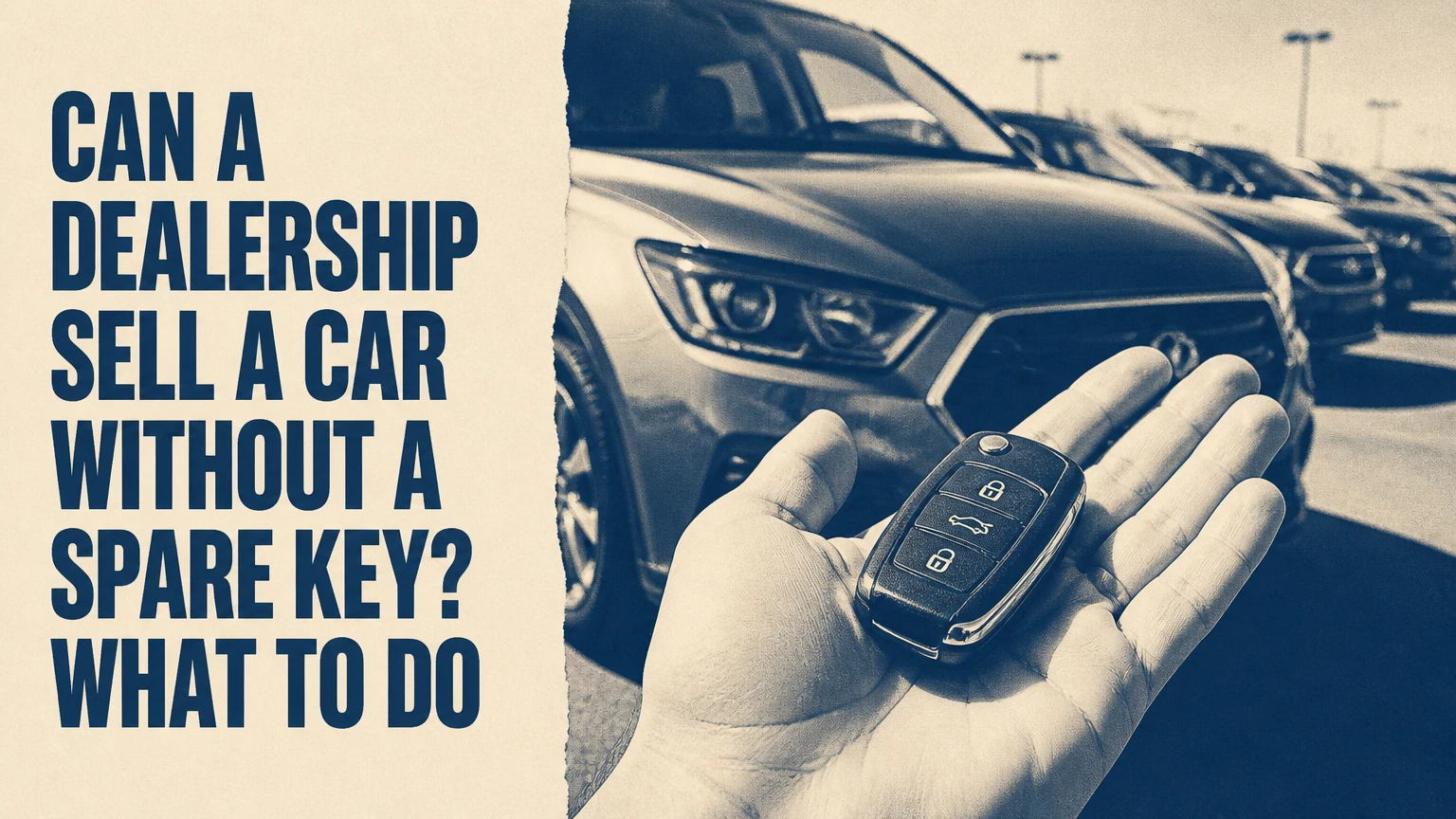
Yes, a dealership can often sell a car with only one working key, especially when the vehicle is used and the sales contract does not promise a second key. The result changes if a written due bill, warranty, disclosure rule, or Certified Pre-Owned program requires another key. Check the keys and paperwork before signing.
Key Facts at a Glance
- A used-car dealer is not automatically required to provide two keys.
- A signed contract or due bill promising a second key can create an obligation to provide it.
- Certified Pre-Owned requirements are manufacturer-specific and may require two functioning keys.
- A replacement key typically costs $10-$50 for a mechanical key and $200-$600 or more for a smart key.
- An automotive locksmith is often cheaper than a franchise dealer for common transponder keys.
- Losing the only working key usually adds towing, ownership verification, and all-keys-lost programming costs.
Can a Dealership Sell a Car Without a Spare Key?
A dealership can generally sell a used car without a spare key when the vehicle is accurately represented, the transaction documents do not promise two keys, and local consumer law does not impose a different disclosure requirement. The dealer may still have to honor a written promise, advertised equipment list, CPO standard, or express warranty.
“Legal” and “reasonable” are separate questions. A one-key sale can be lawful while still being poor value, because a replacement smart fob may cost several hundred dollars and a missing key can reduce convenience and resale appeal. The buyer should treat the number and type of keys as a negotiated vehicle feature, like tires or floor mats.
The Federal Trade Commission’s Used Car Rule requires participating U.S. dealers to display a Buyers Guide describing warranty and as-is status, but the federal rule does not create a universal two-key requirement. State law, dealer advertising, and the signed purchase documents can add obligations.
Why the answer depends on the paperwork
A vehicle listing that says “two keys,” a signed “we owe” form, or an equipment checklist can be stronger evidence than a conversation with a salesperson. Oral statements may sometimes be enforceable under local contract law, but proving the exact promise is difficult, and an integration clause may limit reliance on statements outside the written contract.
Ask the finance manager to identify the number of keys in the buyer’s order, purchase agreement, due bill, or delivery checklist. Use specific wording rather than “spare key included.”
Dealer to provide one additional, correctly cut and programmed working key or smart fob at no cost to buyer by [date]. Replacement must operate the locks, immobilizer, remote functions, and emergency blade where equipped.
What happens with new, used, and CPO vehicles?
New vehicles normally arrive with the complete factory key set, while used vehicles may be sold with one key because the previous owner traded in only one or the dealer chose not to absorb replacement costs. CPO vehicles occupy a separate category because certification rules can require equipment that ordinary used-car sales do not.
| Vehicle category | Typical key expectation | Buyer’s best evidence | Main risk |
|---|---|---|---|
| New vehicle | 2 factory keys or fobs | Window sticker, delivery checklist, owner’s manual | Missing factory equipment |
| Ordinary used vehicle | 1-2 keys | Listing, Buyers Guide, purchase agreement | As-is terms and replacement cost |
| Manufacturer CPO | Brand-specific, often 2 | CPO checklist and certification report | Certification dispute |
| Lease return | 2 original keys commonly expected | Return inspection record | Dealer may charge for absent equipment |
| Auction or trade-in unit | 1 key possible | Vehicle intake and listing records | Unknown prior key status |
A dealer may sell a new vehicle with one key if the missing item is disclosed and the parties agree, but the buyer should ask whether the vehicle was previously titled, used as a demonstrator, or affected by a delivery error. Factory equipment claims deserve written confirmation.
Do CPO cars have to come with two keys?
Many manufacturer CPO programs require two functioning keys, but no universal CPO rule applies to every brand or market. The controlling document is the current certification checklist for that manufacturer, model, and country, not a salesperson’s general statement about CPO vehicles.
Before signing, request the completed CPO inspection report and locate the key requirement. Some programs may permit a missing key if the dealer replaces it before delivery or records an exception. Others may require a particular OEM fob, not merely a generic remote that starts the car.
If a CPO dealer delivers one key despite a two-key certification requirement, photograph the delivered key, retain the checklist, and request a written completion date. Escalate to the dealership’s general manager and the manufacturer’s customer-care department if the dealer refuses to correct a documented certification failure.
What should you check before signing?
Inspect every key, verify every function, and record the agreed key count in the signed transaction documents before taking delivery. A key that unlocks the doors but does not start the engine is not a complete working key for an immobilizer-equipped vehicle.
Use this inspection sequence:
- Count the physical keys and fobs. Record whether each item is an OEM, aftermarket, valet, emergency, or mechanical key.
- Test lock and unlock buttons. Check the driver door, passenger doors, trunk, liftgate, panic function, and remote start if equipped.
- Start the vehicle with each key. Confirm that the immobilizer accepts every key and that no security warning remains illuminated.
- Test proximity operation. With the smart fob in your pocket, lock, unlock, start, and shut down the vehicle.
- Check the emergency blade. Confirm that the blade fits the driver-door cylinder and that the cylinder turns.
- Review the documents. Compare the listing, window sticker, CPO report, Buyers Guide, buyer’s order, and due bill.
- Photograph the evidence. Photograph the keys beside the vehicle identification number and save the listing as a PDF or screenshot.
The most overlooked issue is a previously lost fob that remains enrolled in the car. Ask a dealer or qualified locksmith whether all unknown keys can be erased and only the keys in your possession reprogrammed. On some vehicles, simply adding a new fob does not remove an old one.
How much does a replacement car key cost?
A replacement key typically costs $10-$50 for a basic mechanical key, $50-$150 for a transponder key, $150-$300 for a remote flip key, and $200-$600 or more for a proximity smart fob. Luxury brands, newer encryption systems, and all-keys-lost situations can exceed $800.
These are typical consumer price ranges, not mandated prices. The final bill depends on the vehicle year, immobilizer system, OEM or aftermarket part, local labor rate, whether a working key is available, and whether the key must be ordered by VIN.
| Key type | Typical vehicle use | Typical replacement price | Typical completion time |
|---|---|---|---|
| Mechanical blade | Older vehicles, trunk or emergency blade | $10-$50 | 5-15 minutes |
| Transponder key | Ignition key with RFID chip | $50-$150 | 20-60 minutes |
| Remote flip key | Key blade plus lock remote | $150-$300 | 30-90 minutes |
| Integrated key fob | Remote buttons and immobilizer | $120-$350 | 30-120 minutes |
| Smart proximity fob | Push-button-start vehicles | $200-$600+ | Same day to 3 days |
| Luxury encrypted fob | Newer premium vehicles | $400-$1,000+ | 1-7 days |
A missing spare can therefore represent a material purchase adjustment. If the replacement estimate is $400, negotiate a $400 allowance only after confirming whether the figure includes cutting, programming, taxes, and a mechanical emergency blade.
Which replacement source should you choose?
A franchise dealership provides the most predictable OEM compatibility, an automotive locksmith usually offers the lowest installed price, and online or DIY purchasing has the lowest upfront price but the highest compatibility risk. The right choice depends mainly on vehicle age, key complexity, and whether one working key remains.
| Source | Typical installed cost | Typical time | Best fit | Main limitation |
|---|---|---|---|---|
| Franchise dealer | $180-$1,000+ | 1-7 days | New, luxury, proprietary systems | Highest labor and parts price |
| Mobile automotive locksmith | $90-$500 | 30-120 minutes | Common used vehicles | Coverage varies by make and year |
| Online OEM fob plus professional programming | $80-$400 | 1-7 days | Price-sensitive owners | Wrong part may be nonreturnable |
| DIY programming | $30-$250 | 30 minutes to several hours | Supported older models | Tools and procedures vary |
| Parts counter only | $50-$600 part cost | 1-7 days | Owners arranging programming separately | Usually does not complete the job |
When is an automotive locksmith the better option?
A mobile automotive locksmith is usually the better value for a common vehicle when one working key is available and the locksmith confirms compatibility before dispatch. A qualified locksmith can cut the blade, program the transponder, and test the immobilizer at the vehicle’s location.
Ask for the technician’s business identity, written all-in price, parts brand, programming coverage for your exact year and trim, and warranty duration. A quote that excludes “programming” can become more expensive than the dealer after arrival fees and labor are added.
A locksmith is not the best choice for every car. Some new models require manufacturer credentials, online security access, or a dealer-only procedure. The locksmith should tell you that limitation before accepting payment.
When should you use the dealership?
Use the franchise dealer when the vehicle has a newer encrypted smart-key system, when the manufacturer requires online immobilizer authorization, or when a CPO or due-bill promise requires an OEM key. The dealer can order the correct part by VIN and document the repair in the vehicle’s service history.
The dealer is also the safer route when every key is lost. The service department may need proof of ownership, government identification, registration, and a tow to the dealership before it can erase prior keys and enroll replacements.
Can you program an online key yourself?
An online fob can work, but compatibility must match the vehicle’s exact part number, frequency, transponder type, FCC or regional approval, and programming procedure. A remote that locks the doors may still lack the immobilizer chip required to start the engine.
Before buying, verify the following:
- Vehicle year, make, model, trim, and start system.
- OEM part number printed on the existing fob.
- Radio frequency, such as 315 MHz or 433 MHz, where applicable.
- Transponder or smart-key system compatibility.
- Whether the vehicle permits owner programming.
- Whether an existing working key is required.
- Return policy for cut or programmed items.
Self-programming is practical only when the manufacturer provides a supported procedure and the vehicle permits it. Many modern vehicles need a scan tool, security PIN, subscription access, or an internet-connected programming session. Incorrect procedures can fail without damaging the car, but some systems can delete enrolled keys or leave the owner with no usable key.
A hardware-store kiosk may duplicate certain supported keys, but kiosk availability does not prove immobilizer compatibility. Confirm engine-start operation before leaving.
What if the dealer promised a spare key verbally?
A verbal promise can support a consumer complaint or contract claim in some jurisdictions, but the outcome depends on local law, the signed agreement, and the available evidence. The buyer should immediately create a written record rather than assume the salesperson will remember the promise.
Send a short email or text to the salesperson and manager: “My understanding is that the sale includes one additional programmed key for VIN ending 1234. Please confirm the delivery date and whether the dealer will provide an OEM or equivalent key.” Save the reply, the listing, and all purchase documents.
If the dealer denies the promise, review the entire contract for a due bill, “accessories included” line, arbitration clause, as-is language, and merger or integration clause. Then escalate in this order:
- Salesperson and sales manager.
- General manager or dealer principal.
- Manufacturer customer-care department, for a franchised or CPO dispute.
- State attorney general, motor-vehicle regulator, or consumer-protection agency.
- Private legal advice for a significant replacement cost or misrepresentation claim.
Do not stop making required loan payments while disputing a key promise. A sales dispute and a financing contract are usually separate obligations.
Is selling a car with one key a safety problem?
A single working key is usually a convenience and security concern rather than an automatic mechanical safety defect. The risk becomes more serious if the absent key is still active, the remaining fob has a failing battery, the emergency blade is missing, or the car cannot be secured during a failure.
Replace the fob battery if its condition is unknown, but do not confuse a battery replacement with key duplication. A fresh battery does not create a second key or remove a lost fob from the immobilizer.
Ask for an all-keys reset when the vehicle’s history suggests that another key may be missing. This is especially important after a theft recovery, rental use, fleet ownership, or a prior owner’s lost-fob report.
What happens if you lose the only key?
Losing the only working key usually costs more and takes longer than duplicating a key while one remains. The owner may need a mobile locksmith or tow, proof of ownership, a VIN-based key order, immobilizer erasure, and programming of every replacement key.
| Situation | Typical added requirement | Typical cost effect | Practical response |
|---|---|---|---|
| One working key available | Duplicate and program key | Lowest baseline | Make a spare immediately |
| Fob battery dead | Battery and function test | $5-$25 | Replace battery, then test start |
| Key damaged but recognized | New shell or fob programming | $50-$400 | Preserve the original transponder |
| All keys lost, common model | Vehicle access and immobilizer programming | $150-$600 | Call a mobile locksmith first |
| All keys lost, luxury model | Tow, OEM order, security authorization | $500-$1,000+ | Confirm dealer procedure and documents |
Keep the registration, title or finance information, and identification available. A legitimate professional should verify that the person requesting programming has authority over the vehicle.
Which mistakes make the problem more expensive?
The most expensive mistake is waiting until the only key disappears, because all-keys-lost programming can require towing and security resets. The second is buying a visually identical online fob without matching the part number and immobilizer system.
Avoid these failures:
- Relying on a verbal promise: Put the exact key obligation in a signed due bill.
- Accepting a non-starting remote: Test engine start, not only door buttons.
- Ignoring an active lost key: Request an all-keys reset when ownership history is uncertain.
- Buying by appearance: Match the OEM part number, frequency, chip, and region.
- Assuming CPO means two keys: Read the specific manufacturer checklist.
- Comparing parts-only prices: Include cutting, programming, tax, travel, and towing.
- Leaving with an unresolved promise: Obtain a completion date and a named responsible department.
A practitioner rule of thumb is to obtain the second key before the first key becomes unreliable. Key programming is generally simpler with a recognized key, and a buyer can compare locksmith and dealer prices without an immobilized vehicle.
What should each type of buyer do?
The best response differs by vehicle complexity and bargaining position. A buyer of a common used vehicle should usually negotiate the key into the sale or obtain a locksmith quote, while a CPO or luxury buyer should insist on documented compliance before accepting delivery.
Budget-conscious used-car buyer
Request a price reduction equal to a written locksmith estimate, then arrange a high-quality replacement immediately. Choose a locksmith that supplies a parts-and-labor warranty and confirms the exact vehicle configuration.
New-car buyer
Ask the delivery specialist to demonstrate every factory key and remote function. A missing key should be treated as a delivery discrepancy, not an accessory that can be casually added later.
CPO buyer
Check the current CPO checklist before signing and photograph both keys with the vehicle. If the certification requires two, write the replacement obligation into the due bill with an agreed deadline.
Luxury or push-button-start buyer
Prefer the franchise dealer or a locksmith with documented coverage for the exact model year. An aftermarket fob that appears functional may fail authentication, remote-start authorization, or emergency-start procedures.
Buyer who already completed the sale
Review the signed documents first, then request a written quote from both a dealer and a mobile locksmith. If the key was promised in writing, pursue fulfillment before paying independently unless delay prevents safe or practical vehicle use.
Key replacement cost and decision checklist
Before agreeing to a one-key vehicle, calculate the replacement cost, identify the programming route, and determine whether the missing key creates a security issue. A $75 transponder key and a $600 encrypted proximity fob are materially different negotiating problems.
Use this final checklist:
- Count every supplied key and identify its type.
- Test engine start, remote buttons, proximity sensors, and emergency blade.
- Search the listing and paperwork for “two keys,” “spare,” or “complete set.”
- Read the Buyers Guide and CPO inspection report.
- Obtain two written replacement quotes.
- Ask whether all unknown keys can be erased.
- Record the promise in the buyer’s order or due bill.
- Set a delivery date for any promised key.
- Confirm whether programming, cutting, tax, and warranty are included.
- Photograph the vehicle identification number and supplied keys.
Frequently Asked Questions
Can I return a car because it has only one key?
A one-key vehicle does not automatically create a return right. Return rights depend on state or country law, dealer policy, financing terms, misrepresentation, and whether the contract promised two keys. Review the signed documents promptly, because some jurisdictions impose short notice periods for fraud or consumer complaints.
Does a missing spare key lower a car’s value?
A missing spare key can lower practical and resale value by the cost of a replacement and by reducing buyer confidence. The effect is largest for smart-key vehicles, where a second fob commonly costs $200-$600 or more. A documented price adjustment can offset the expense if the buyer obtains the key promptly.
Can a dealer charge me for a second key after the sale?
A dealer can generally charge for a second key when the original sale included only one and no warranty, advertisement, CPO rule, or written promise says otherwise. The dealer should disclose the price before ordering the part. A written due bill may instead require the dealer to supply it at no charge.
Does a valet key count as a spare key?
A valet key may not count as a full spare because it can restrict trunk access, glove-box access, remote functions, or keyless starting. Ask the dealer to identify whether the item starts the engine, operates all locks, and includes the required remote functions. Contract wording should specify “fully functioning key or fob.”
Can a locksmith make a key without the original?
An automotive locksmith can often create and program a key without the original, but the process requires vehicle access, VIN information, ownership proof, and equipment compatible with the immobilizer. All-keys-lost service usually costs more than duplication with a working key and may require a tow for newer vehicles.
Should I negotiate a spare key or a lower purchase price?
Negotiate the documented replacement cost rather than an arbitrary discount. If a dealer will provide a correctly programmed key within a defined timeframe, that is usually more useful than a small price reduction; if delivery is uncertain, a discount equal to a written quote gives the buyer control.
The Bottom Line
A dealership can often sell a car with one key, but the dealer must still honor applicable law, advertising, CPO standards, warranties, and signed promises. Before accepting the vehicle, test the supplied key, price the correct replacement, and put any second-key obligation in writing. If the buyer already owns the vehicle, a qualified locksmith is often the economical first option, while newer encrypted and luxury systems may justify dealer programming. The answer to can a dealership sell a car without a spare key is therefore usually yes, but the contract and vehicle program determine who pays for the missing key.