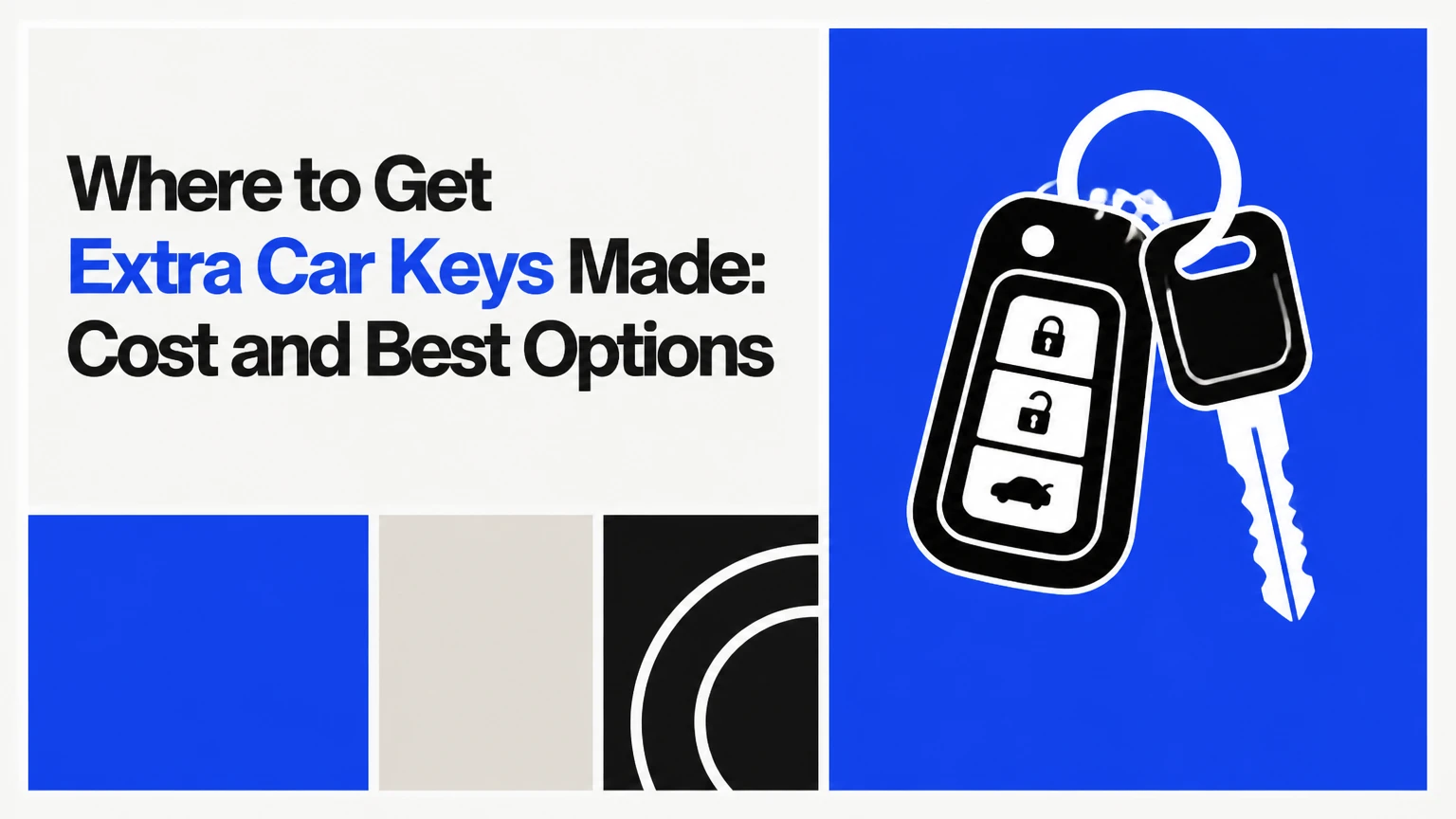
You can get extra car keys made at an automotive locksmith, an authorized dealership, or, for some older vehicles, a hardware store or self-service kiosk. A locksmith usually offers the best balance of price and convenience, while a dealership is safest for proprietary smart keys; hardware stores generally handle only mechanical keys and selected older transponder models.
Key Facts at a Glance
- A mechanical car key may cost $5-$35 and take 5-15 minutes to duplicate.
- A programmed transponder key typically costs $50-$250 through an automotive locksmith.
- A dealership replacement commonly costs $150-$600 or more for smart keys and luxury vehicles.
- A key that turns the ignition can still fail to start the engine if its immobilizer chip is unprogrammed.
- A working original key usually reduces duplication time, programming difficulty, and total cost.
- Proof of ownership, photo identification, and the vehicle identification number may be required.
Where Can You Get Extra Car Keys Made?
The best place depends on the key technology, whether you have a working original, and whether the vehicle is accessible for programming. An automotive locksmith is usually the practical first choice for ordinary vehicles because mobile technicians can cut and program many keys at the vehicle. A dealership becomes more attractive when the manufacturer uses restricted software or a proprietary smart-key system.
| Provider | Typical price | Typical time | Best fit |
|---|---|---|---|
| Hardware store | $5-$25 | 5-15 minutes | Metal key, older vehicle |
| Key kiosk | $10-$35 | 5-20 minutes | Supported duplicate key |
| Automotive locksmith | $50-$250 | 15-60 minutes | Transponder, remote-head, mobile service |
| Authorized dealership | $150-$600+ | 30 minutes to 2+ hours | OEM smart key, restricted programming |
| Online retailer plus local programming | $25-$200 before labor | 1-7 days plus appointment | Price-sensitive owner who verifies compatibility |
Automotive Locksmith
An automotive locksmith is generally the best option for a spare transponder key, remote-head key, or many proximity fobs. The technician may use a key-code database, an original key, a laser cutter, and manufacturer-specific diagnostic equipment while working at your home, workplace, or roadside location.
Ask for the complete price before authorizing the job. The quote should identify the key type, cutting fee, programming fee, mobile-service fee, tax, and any charge for deleting lost keys. A low advertised price may cover only a metal blade.
A locksmith is not automatically qualified for every make. Ask whether the technician has programmed your exact year, model, and trim, and whether the replacement is OEM, aftermarket, or refurbished.
Authorized Dealership
A dealership is the most predictable source for an OEM key fob and manufacturer-authorized programming. It is often the right choice for newer luxury vehicles, encrypted proximity systems, vehicles with unusual key-registration procedures, or cases where an independent locksmith confirms that third-party tools cannot complete the job.
Dealership service costs are usually higher because the price may include an OEM fob, factory key code, programming labor, and parts handling. If all keys are missing, the vehicle may need to be present at the dealership, which can add towing expenses.
A dealership is not always the fastest option. Parts may need to be ordered, and some brands require a security authorization process before the key can be released.
Hardware Stores and Key Kiosks
Hardware stores and kiosks are suitable when the vehicle uses a plain metal key and the blank is available. Stores such as Ace Hardware, Home Depot, Lowe’s, and automotive retailers vary by location, equipment, and vehicle coverage, so availability must be confirmed before travel.
A copied blade may unlock the door yet fail to start the engine when the original key contains an immobilizer transponder. Kiosks can identify and duplicate some supported electronic keys, but coverage is model-specific and generally does not extend to complex push-to-start fobs.
What Type of Car Key Do You Have?
The key type determines whether duplication means copying metal, cloning an electronic identifier, programming a new identifier, or completing all three tasks. Inspect the key and ignition before requesting a quote, because the same vehicle model can have different key systems by year and trim.
| Key type | Identifying feature | Cutting requirement | Programming requirement |
|---|---|---|---|
| Mechanical key | Metal blade, no buttons or chip | Standard duplicator | None |
| Transponder key | Plastic head with hidden chip | Standard or high-security cutter | Immobilizer pairing |
| Laser-cut key | Thick blade with center groove | Sidewinder cutting machine | Often required |
| Remote-head key | Blade and lock buttons in one housing | Vehicle-specific cutter | Remote and immobilizer setup |
| Smart or proximity fob | Push-button start, no normal ignition slot | Optional emergency blade | Fob registration and vehicle pairing |
Mechanical Keys
A traditional mechanical key contains a shaped metal blade without an electronic immobilizer chip. A hardware store can usually copy it from a working original, although a worn original can transfer its inaccuracies to the duplicate.
A code-cut key made from the manufacturer’s key code may be more accurate than a copy of a damaged blade. Test the duplicate in the door and ignition before leaving the store.
Transponder Keys
A transponder key contains a passive chip that communicates with the vehicle’s immobilizer. The blade may be cut correctly, but the engine will not run unless the chip’s identifier is accepted by the vehicle.
Some vehicles allow owner-programming with two already-programmed keys. Many do not. Do not assume a start-key procedure found online applies to your specific year, because failed attempts can erase or restrict previously registered keys on some systems.
Laser-Cut and Sidewinder Keys
A laser-cut, or sidewinder, key has a precisely milled groove and usually requires a specialized machine. A hardware-store duplicator designed for edge-cut blades cannot reproduce it accurately.
The key may also contain a transponder or remote circuit. Cutting and programming are separate charges, even when one provider performs both tasks.
Remote-Head Keys and Smart Fobs
A remote-head key combines a physical blade with buttons for locking and unlocking. A smart fob communicates with the vehicle by proximity signals and normally supports push-button starting.
Remote buttons and engine authorization are separate functions. A fob can lock the doors while its immobilizer registration remains incomplete, which explains many apparent programming failures.
What Should You Bring Before Making a Spare Key?
Bring the vehicle, one working key if available, a government-issued photo ID, and proof of ownership. The provider also needs the exact year, make, model, trim, ignition type, and sometimes the 17-character VIN to identify the correct key and authorize programming.
Preparation Checklist
- Record the VIN. Find it on the dashboard near the windshield, the driver-side doorjamb label, registration, or insurance documents.
- Confirm the vehicle details. Note the model year, make, model, trim, engine, and whether the ignition uses a key cylinder or push button.
- Bring ownership documents. Registration, title, or insurance documentation may be accepted, but requirements differ by provider and jurisdiction.
- Bring every existing key. A locksmith can test which keys start the engine and determine whether the vehicle has reached its programming limit.
- Photograph the key. Capture the front, back, buttons, FCC or part number, and blade profile before requesting online prices.
- Ask about key status. Confirm whether the quote covers an OEM, aftermarket, refurbished, or shell-only product.
The key code may appear in original paperwork or a metal tag, but it is not universally supplied to owners. A provider can often retrieve the code through authorized databases using the VIN and ownership verification.
How Is an Extra Car Key Made?
An extra car key is made through identification, blank selection, mechanical cutting, electronic programming, and functional testing. The process usually takes 15-60 minutes when a working key and compatible blank are available, but a dealership order or all-keys-lost situation can take several hours or days.
Step 1: Verify the Vehicle and Ownership
The provider confirms the VIN, vehicle identity, and customer authorization. This protects against unauthorized key creation and gives the technician the information needed to select the correct key system.
Success checkpoint: The provider can state the exact key type and whether programming is included.
Common mistake: Giving only the model name without the year and trim.
Step 2: Match the Blank or Fob
The provider selects a mechanical blank, transponder key, remote-head unit, or proximity fob. Frequency, chip type, blade profile, button configuration, and manufacturer compatibility all matter.
Success checkpoint: The part number or compatibility is confirmed before cutting.
Common mistake: Buying a visually identical fob with a different frequency or incompatible immobilizer chip.
Step 3: Cut the Mechanical Blade
The technician duplicates the working key or cuts the blade from a key code. High-security blades require a sidewinder machine, while standard edge-cut keys use a conventional duplicator.
Success checkpoint: The new blade turns the door and ignition smoothly without forcing.
Common mistake: Testing only the door lock and assuming the ignition cut is accurate.
Step 4: Program the Immobilizer
The technician connects approved diagnostic equipment, commonly through the OBD-II port, and registers the new transponder or smart fob with the vehicle. The exact procedure varies by manufacturer and may require security credentials, a PIN, or an online account.
Success checkpoint: The engine starts with the new key, not merely the locks responding.
Common mistake: Treating remote lock-button operation as proof that starting authorization works.
Step 5: Test Every Function
Test engine starting, door locking, unlocking, trunk release, panic alarm, remote start, emergency blade operation, and dashboard security warnings. The owner should also verify that all existing keys still work.
Success checkpoint: Every requested function works from a normal operating distance.
Common mistake: Leaving before discovering that the trunk button, proximity detection, or emergency blade was not configured.
How Much Does an Extra Car Key Cost?
An extra car key typically costs $5-$35 for a mechanical duplicate, $50-$250 for a programmed transponder or remote-head key, and $150-$600 or more for a smart fob through a dealership. Vehicle age, key technology, OEM versus aftermarket parts, local labor, and whether the vehicle is mobile determine the final price.
| Replacement situation | Typical parts cost | Typical labor or service cost | Typical total |
|---|---|---|---|
| Plain metal duplicate | $3-$15 | $2-$20 | $5-$35 |
| Laser-cut blade | $20-$80 | $20-$70 | $40-$150 |
| Transponder key with one working key | $25-$120 | $25-$130 | $50-$250 |
| Smart fob through locksmith | $80-$300 | $50-$200 | $130-$500 |
| Smart fob through dealership | $150-$450 | $50-$200 | $200-$650+ |
| All keys lost, mobile service | $50-$300 parts | $100-$400 service | $150-$700+ |
These are typical North American planning ranges, not fixed prices. Luxury European vehicles, unusual key systems, immobilizer resets, towing, after-hours labor, and key-memory deletion can push the total higher.
A spare made while one original key works usually costs less than replacing the only lost key. The working key provides a reference for cutting and may allow a simpler programming procedure.
Which Provider Is Best for Your Situation?
Choose an automotive locksmith for most ordinary transponder and remote-head duplicates, a hardware store for a confirmed mechanical-only key, and a dealership for restricted or high-end smart-key systems. The correct decision depends more on key technology and programming access than on vehicle age alone.
| Situation | First provider to call | Why | Main limitation |
|---|---|---|---|
| Plain metal key | Hardware store | Lowest price and fastest cutting | Cannot add immobilizer functions |
| One working transponder key | Automotive locksmith | Mobile programming and moderate cost | Coverage varies by make |
| Push-to-start commuter vehicle | Qualified automotive locksmith | Often avoids dealership labor rates | Some newer systems are restricted |
| BMW, Mercedes-Benz, or Audi smart key | Authorized dealership | OEM authorization and secure parts | Higher price and possible order delay |
| All keys lost at home | Mobile automotive locksmith | Cuts and programs at the vehicle | May require security reset or towing |
| Stolen key | Locksmith or dealership | Can erase missing key credentials | Not every system supports the same deletion method |
| Online replacement fob | Retailer, then qualified programmer | Potential parts savings | Wrong part may be unusable |
When Is a Locksmith Better Than a Dealership?
A locksmith is usually better when the vehicle is accessible, at least one key remains, and the technician supports the exact make and model. Mobile service eliminates towing, while independent labor often costs less than dealer labor.
A dealership is better when the manufacturer restricts key orders, the vehicle requires online factory authorization, or a locksmith cannot verify compatibility. Get two itemized quotes because the cheapest initial price may exclude programming or mobile travel.
Can a Hardware Store Make Your Car Key?
A hardware store can make a car key when the vehicle uses a supported mechanical blank or a store-supported electronic key. Most hardware stores cannot program modern proximity fobs, and store capability differs by location.
Call first with the year, make, model, and a photograph of the key. If the key has a transponder, ask specifically whether the store duplicates and programs that chip, rather than asking only whether it cuts automotive keys.
Do Online Car Key Fobs Work?
Online car key fobs can work, but compatibility must be verified by part number, frequency, chip type, blade configuration, and vehicle programming requirements. A remote may look correct and still fail because it was previously locked to another vehicle, uses a different frequency, or lacks the required immobilizer chip.
Before buying, obtain the original fob’s part number and FCC ID where applicable. Confirm whether the seller accepts returns for programmed or opened electronics, and ask the locksmith whether customer-supplied parts are accepted.
A shell-only purchase replaces cracked plastic but does not provide a new circuit board or transponder. A battery replacement also does not create a spare key. The vehicle still needs a registered electronic credential.
What Changes If You Lost Every Key?
When every key is lost, the provider must create a key without an operating reference, gain vehicle access, cut the blade from a code or decode the lock, and program a new credential. Typical all-keys-lost service costs $150-$700 or more because mobile labor, emergency entry, security resets, and towing may be added.
The vehicle usually must be present for programming. A dealership may require a tow to its service department, while a capable mobile locksmith can complete the job on-site for supported vehicles.
Ask whether the missing keys will be removed from the vehicle’s authorized-key list. Erasing stolen or lost credentials reduces the chance that someone can start the vehicle with a recovered key, although door access, alarm behavior, and system capabilities differ by make.
Common Problems and Their Fixes
Most failed duplicates result from an incorrect part, incomplete programming, inaccurate cutting, or a weak vehicle or fob battery. Diagnose the failed function before paying for another key, because a new battery cannot fix an unregistered immobilizer chip.
| Symptom | Likely cause | Correct response |
|---|---|---|
| Blade turns, engine will not start | Transponder unprogrammed or wrong chip | Return for immobilizer programming |
| Lock buttons work, engine will not start | Remote paired, start credential not paired | Request complete fob registration |
| Key will not enter ignition | Incorrect blade profile or cut | Stop forcing it and have the blade checked |
| Fob works only nearby | Weak coin-cell battery or antenna issue | Install the specified battery and retest |
| Existing key stopped working | Programming procedure changed key memory | Have all keys re-registered |
| Vehicle says key not detected | Dead battery, interference, or failed pairing | Use emergency detection position and obtain diagnosis |
Do not force a stiff blade or spray oily lubricant into an ignition cylinder. A damaged ignition can turn a low-cost key issue into a lock-cylinder repair.
Expert Rules That Prevent Expensive Mistakes
Make a spare before the last key disappears. The original key provides both a cutting reference and a known-good electronic pattern. Waiting until all keys are lost adds vehicle-access and security-programming work.
Separate remote entry from engine authorization. Lock and unlock buttons can function even when the immobilizer chip is absent, wrong, or unregistered. Always test the engine start and dashboard security indicator.
Treat a worn original as unreliable cutting data. Copying a badly worn blade can reproduce its accumulated error. A code-cut replacement may be more accurate when the locksmith can obtain the manufacturer’s bitting information.
Ask about the vehicle’s key limit. Some vehicles store a finite number of authorized keys. A technician may need to re-register the complete set, and leaving an existing key out of the procedure can disable it.
Get the total quote in writing. Request separate prices for the part, cutting, programming, mobile service, tax, emergency access, and deletion of missing keys. This prevents a $40 advertised key from becoming a $250 appointment.
A Practical Decision Process
Use the following sequence when arranging a spare:
- Identify whether the vehicle has a metal key, transponder, remote-head key, or smart fob.
- Confirm whether at least one key starts the engine.
- Call an automotive locksmith and dealership, unless the key is clearly mechanical-only.
- Provide the year, make, model, trim, VIN, key photograph, and current-key count.
- Ask for an all-in price and an estimated completion time.
- Confirm ownership documents and whether the vehicle must be present.
- Test every key function before accepting the work.
- Store the spare separately from the primary key, preferably where a trusted household member can access it.
Roadside assistance may cover lockout entry but not the full cost of key cutting and programming. Check the policy, vehicle warranty, lease agreement, or insurance endorsement before paying out of pocket.
Frequently Asked Questions
Can I Get a Spare Car Key Without the Original?
Yes, a locksmith or dealership can often create a key without the original by using the VIN, manufacturer key code, lock decoding, or authorized immobilizer procedures. The vehicle must generally be present for programming, and proof of ownership is normally required. The price is higher because decoding, access, and security work may be necessary.
Does AutoZone Make Extra Car Keys?
AutoZone sells selected replacement keys, remotes, and key-fob batteries, but cutting and programming availability depends on the product and location. A store may duplicate a supported basic key or provide a compatible replacement, while complex transponder and proximity systems may require an automotive locksmith or dealership.
How Long Does It Take to Make a Spare Car Key?
A mechanical duplicate usually takes 5-15 minutes. A locksmith-made transponder or remote key commonly takes 15-60 minutes when the part is in stock and one working key is available. Dealership orders, restricted smart fobs, and all-keys-lost cases can take several hours or multiple days.
Can a Locksmith Program a Key Fob?
An automotive locksmith can program many transponder keys, remote-head keys, and smart fobs, but coverage depends on the vehicle’s year, make, model, security system, and available diagnostic access. Ask for confirmation for the exact vehicle before scheduling. Some proprietary systems require dealership authorization or an OEM-only part.
Is It Cheaper to Buy a Car Key Online?
Buying online can reduce the parts price, but the total may not be lower after cutting, programming, shipping, returns, and an additional service appointment. Online purchasing makes financial sense only when the part number, frequency, chip, blade, and programming policy have been confirmed by a qualified provider.
Should I Delete a Lost Car Key From the Vehicle?
Yes, request deletion when a key is lost or stolen and the vehicle supports that function. Deletion prevents the missing credential from starting the engine, although it may not prevent mechanical door entry on every vehicle. Bring all remaining keys so the provider can preserve their authorization during the reprogramming process.
The Bottom Line
Where to get extra car keys made depends on the key system and your current key supply. Use a hardware store for a confirmed mechanical key, choose a qualified automotive locksmith for most programmed duplicates and mobile service, and use an authorized dealership when the vehicle requires proprietary OEM programming. Bring the VIN, ownership documents, every working key, and the exact vehicle details, then confirm that the quoted price includes both cutting and electronic programming.