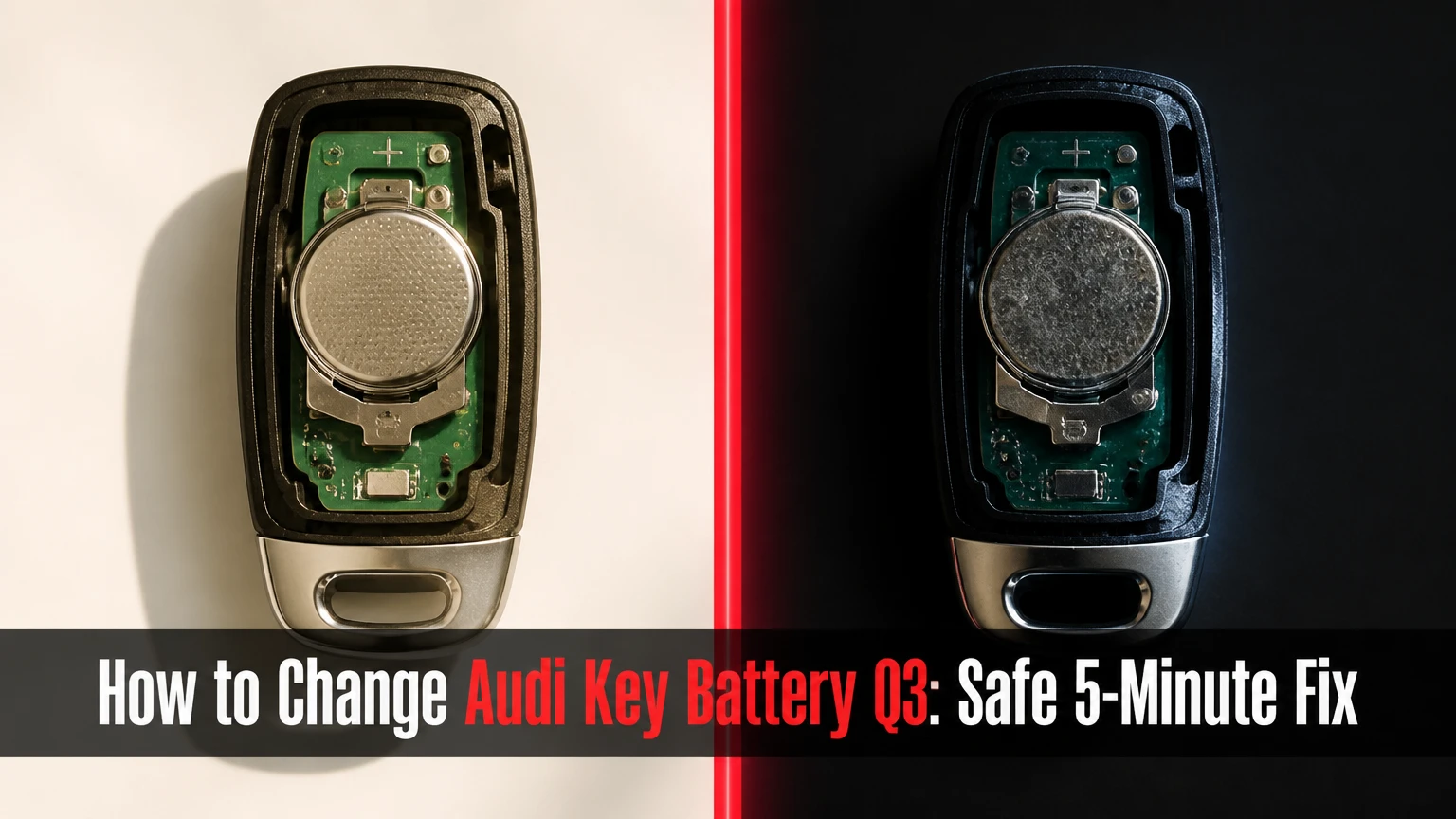
To change an Audi Q3 key battery, identify the fob design, remove its cover or battery tray, and install a fresh CR2032 lithium coin cell in the orientation marked inside the key. The job usually takes 2-5 minutes and does not erase key programming, but polarity and housing design determine the correct procedure.
Key Facts at a Glance
Most Audi Q3 key fobs use a CR2032, 3-volt lithium coin-cell battery.
A normal replacement does not require immobilizer or remote-key reprogramming.
Older flip-key fobs open through the mechanical-key cavity; newer smart keys use a removable battery tray.
Battery polarity is design-specific, so the marking inside the tray takes priority over a generic online instruction.
A typical DIY replacement costs about $2-$8 and takes less than five minutes.
A Q3 with a depleted remote battery may still start through its emergency-start recognition position.
Which Q3 Key Design Do You Have?
The Audi Q3 key design determines how the battery compartment opens. An older 8U-generation fob, commonly fitted to approximately 2011-2018 Q3 vehicles, normally has a spring-loaded flip-out metal blade, while many newer F3-generation fobs have a separate emergency key and a slide-out battery tray.
Model year is a useful clue, not a sufficient identification method. Audi markets, equipment packages, replacement housings, and regional parts can create exceptions. Inspect the key before inserting a tool.
| Physical feature | Older flip-key fob | Newer smart-key fob | Correct first action |
|---|---|---|---|
| Metal blade | Swings out after pressing a silver button | Pulls completely out of the housing | Remove or extend the blade |
| Battery access | Split rear cover near blade cavity | Tray inside emergency-key slot | Locate seam or tray tabs |
| Common Q3 range | 2011-2018, 8U generation | 2019-present, F3 generation | Confirm by shape |
| Typical cell | CR2032, 3 volts | CR2032, 3 volts | Read tray marking |
| Opening method | Gentle lift at molded seam | Squeeze or release tray tabs | Do not force the shell |
A key with a flip-out blade is not automatically identical to every other Audi switchblade key. The number printed on the rear housing, the replacement-key part number, and the polarity symbol inside the compartment provide stronger evidence than a generic year chart.
What should you prepare first?
Prepare one new CR2032 cell, a clean table, and either a fingernail, a plastic pry tool, or a small blunt coin. A metal screwdriver can work on the older shell, but a plastic tool reduces scratches and prevents accidental contact between metal and the battery terminals.
Before opening the fob, check the replacement cell for a clear 3-volt CR2032 label, intact packaging, and a removable protective film. Do not substitute a CR2025 merely because it has the same diameter. The CR2025 is thinner, which can reduce terminal pressure and cause intermittent operation in a compartment designed for a CR2032.
Keep the replacement battery away from children and pets. The U.S. Consumer Product Safety Commission treats button and coin cells as an ingestion hazard, especially when a child can access the cell or an unsecured key housing.
Which Battery Does an Audi Q3 Key Use?
Most Audi Q3 remote keys use a CR2032 lithium battery rated at 3 volts, but the installed cell and the housing marking should be checked before purchase. A genuine CR2032 from a reputable battery manufacturer is the safest default; the fob’s internal marking and the vehicle-specific owner’s manual control when they differ from a general fitment guide.
A CR2032 is a lithium manganese-dioxide coin cell. Energizer’s CR2032 technical information lists a nominal 3-volt voltage and a typical capacity that depends on discharge conditions, temperature, and cutoff voltage. Keyless-entry fobs draw very small current most of the time, but repeated proximity detection and frequent button presses shorten practical life.
| Battery choice | Voltage | Thickness | Use in Q3 key | Typical retail price |
|---|---|---|---|---|
| CR2032 lithium coin cell | 3.0 V | 3.2 mm | Standard choice for most Q3 fobs | $2-$8 per cell |
| CR2025 lithium coin cell | 3.0 V | 2.5 mm | Usually too thin for a CR2032 slot | $1-$5 per cell |
| CR2016 lithium coin cell | 3.0 V | 1.6 mm | Not a dimensional substitute | $1-$5 per cell |
| Rechargeable LIR2032 cell | 3.6 V nominal | 3.2 mm | Not suitable for a 3-volt CR2032 circuit | $3-$10 per cell |
Buy a sealed, in-date cell from a battery retailer, electronics shop, automotive parts store, or established online seller. A low price is not proof of poor quality, but loose cells with unclear manufacturing dates carry more uncertainty than sealed cells from Panasonic, Energizer, Duracell, Maxell, or another established manufacturer.
How to Change an Audi Q3 Key Battery
The complete replacement process is simple: identify the housing, expose the cell, photograph or note its orientation, install the matching CR2032, close the housing, and test every function. The most important success factor is not speed; it is preserving the battery-contact spring and confirming the polarity symbol before the old cell leaves the compartment.
Type 1: Replace the Flip-Key Battery
Use the flip-key procedure when the Audi Q3 fob has a blade that pivots outward from the housing.
- Extend the metal key blade. Press the silver release button and allow the blade to flip out. The open blade exposes the recessed area where the rear cover normally separates.
- Find the molded housing seam. Look inside or beside the blade cavity for a narrow joint in the plastic. The seam may be subtle, so use a bright light rather than inserting a tool blindly.
- Lift the battery cover gently. Insert a fingernail, plastic pick, or blunt coin into the seam and twist slightly. Work along the molded edge instead of prying against a button, hinge, or thin retaining clip.
- Record the old battery orientation. Before removal, photograph the cell in place and identify the plus sign. Some switchblade housings commonly place the positive face upward, but the individual fob marking is authoritative.
- Remove the old CR2032. Slide the cell out from the accessible edge without bending the metal contact. If a retaining tab holds the cell, release the tab with a plastic tool rather than levering against the circuit board.
- Install the replacement cell. Push the new CR2032 under the retaining lip and press it down until it lies flat. The plus and minus orientation must match the symbol or the old-cell position.
- Refit the cover. Align the housing edges and press around the perimeter until each clip engages. Do not squeeze the shell at one corner only, because that can leave a gap or crack a clip.
- Test the fob. Press lock and unlock beside the Q3, then test the trunk button and mechanical blade. Confirm that the key starts the vehicle or that the keyless-start system recognizes it.
Success checkpoint: the battery sits flat, the cover closes flush, and the vehicle responds from a normal distance.
Common mistake: forcing the rear cover while the blade mechanism remains misaligned, which can damage the plastic latch.
Type 2: Replace the Smart-Key Battery
Use the smart-key procedure when the Audi Q3 fob has a removable emergency blade and a separate battery tray inside the blade slot.
- Release the emergency key. Press the release buttons or slider on the fob and pull the metal emergency blade completely out. Keep the blade aligned with the slot so it does not scrape the housing.
- Inspect the empty blade channel. Look for two small tabs, a tray edge, or an embossed release symbol. The battery tray is usually visible only after the emergency key has been removed.
- Release and pull the tray. Squeeze the tray tabs with your fingers or use the blunt edge of the emergency blade. Pull straight outward; rocking the tray sideways can deform its guides.
- Check the polarity marking. The tray often indicates whether the positive face points toward the tray or toward the cover. Do not assume that a newer Q3 key uses the same orientation as an older flip key.
- Remove the old cell. Lift it from the exposed edge while avoiding the terminal spring. Inspect the tray for white residue, green corrosion, cracked plastic, or a flattened contact.
- Fit the new CR2032. Insert the cell into the tray at the marked angle, then press it down until it is retained. A loose cell can interrupt power when the key moves in a pocket.
- Reinstall the tray. Slide the tray into the fob until it stops and clicks. The tray should remain flush with the housing and should not require force.
- Reinsert the emergency key. Push the blade into its slot until the release mechanism locks it. Test removal once to verify that the latch still works.
- Test all functions. Check lock, unlock, trunk release, passive entry if fitted, and push-button starting. Test from several metres away rather than directly beside the vehicle.
Success checkpoint: the tray clicks into place and the fob responds consistently without squeezing the housing.
Common mistake: installing the cell based on a video for a different Audi key, whose tray polarity or release arrangement may differ.
How Should the Battery Face?
The positive and negative faces of an Audi Q3 key battery must match the polarity symbol inside the specific fob. In many older flip-key housings the positive face is commonly visible upward, while some newer tray-style keys place the positive face downward into the tray, but these are practical patterns rather than a substitute for inspection.
The positive face is usually the flat side marked with a plus sign and manufacturer lettering. The negative face is commonly the less-marked underside. Hold the cell by its edge, because fingerprints rarely prevent operation by themselves, but clean contact surfaces and correct seating reduce avoidable intermittent faults.
A polarity error usually causes immediate failure rather than gradual weak performance. Remove the battery, turn it over, reinstall it, and retest before assuming that the fob lost programming.
How long should the new battery last?
An Audi Q3 key battery commonly lasts 2-4 years, although heavy button use, frequent proximity detection, extreme cold, and a fob stored near the vehicle can shorten that interval. A spare key used only occasionally may last longer, while a daily-use comfort-access key can show a low-battery warning sooner.
A key stored directly beside the parked Q3 may communicate more often than a key kept several metres away. The difference is not universal, but separating the key from the vehicle overnight is a sensible diagnostic step when a new cell drains unusually quickly.
Replace the battery when the Q3 displays a key-battery warning, the operating range becomes inconsistent, or the vehicle recognizes the fob only when it is close to the door or start area. Do not wait until the remote stops completely if the warning has appeared.
What Does an Audi Q3 Key Battery Replacement Cost?
A DIY Audi Q3 key battery replacement typically costs $2-$8 and takes 2-5 minutes. A hardware-store, locksmith, or automotive service counter may charge about $5-$20, while a dealership commonly charges approximately $20-$50 for a simple battery service, with local labor rates and currency creating substantial variation.
These are typical retail ranges, not fixed Audi prices. A dealership may charge more when the appointment includes key inspection, diagnostic testing, a replacement housing, or a new programmed key rather than a coin-cell swap.
| Replacement route | Typical parts cost | Typical labor cost | Total typical cost | Time |
|---|---|---|---|---|
| DIY with branded CR2032 | $2-$8 | $0 | $2-$8 | 2-5 minutes |
| Hardware or watch counter | $2-$8 | $0-$12 | $5-$20 | 5-15 minutes |
| Automotive locksmith | $2-$10 | $10-$30 | $12-$40 | 10-25 minutes |
| Audi dealership | $2-$10 | $18-$40 | $20-$50 | 15-45 minutes |
The dealership makes sense when the fob has water damage, a broken shell, an unresponsive button, or a second fault that a battery cannot explain. DIY is appropriate when the housing is intact and the owner can identify the polarity without forcing the clips.
DIY or Dealership: Which Option Is Better?
DIY replacement is the better choice for an intact Audi Q3 fob because the task costs less than $10 and normally requires no programming. A locksmith or dealership is preferable when the key has physical damage, repeated battery drain, corrosion, or a vehicle that fails to recognize a confirmed-good fob.
| Owner situation | Best route | Reason | Expected cost |
|---|---|---|---|
| Warning appears, buttons still work | DIY | Lowest cost and simple access | $2-$8 |
| Shell clips are cracked | Locksmith or dealer | Replacement housing may be needed | $20-$100 |
| Battery dies again within weeks | Diagnostic inspection | Possible contact, button, or circuit fault | $20-$100 |
| Remote and spare both fail | Vehicle-side diagnosis | Receiver, fuse, or vehicle battery may be involved | $50-$150+ |
| Key is lost or immobilizer is damaged | Audi dealer or qualified locksmith | Programming and security verification required | $150-$500+ |
An honest limitation matters here: replacing the coin cell cannot repair a failed transmitter, damaged circuit board, broken button membrane, or vehicle receiver. A fresh battery proves only that the fob has a new power source.
Can an Audi Q3 Start With a Dead Key Battery?
An Audi Q3 can often start with a depleted key battery by using the vehicle’s emergency key-recognition position, but the exact location varies by generation and equipment. The emergency procedure restores authorization for starting; it does not restore remote locking, passive entry, or a damaged transmitter.
First unlock the vehicle with the mechanical emergency blade if the remote does not work. Enter the cabin, hold the fob against the designated key-recognition area shown in the Q3 owner’s manual, and press the brake and Start button, or follow the instrument-cluster prompt.
Some Q3 versions place the recognition area near the steering column, while others use a marked console or a specified position in the cupholder area. Do not rely on a generic video if the dashboard gives a different instruction. The owner’s manual for the vehicle identification number is the definitive source.
If emergency starting works but the buttons do not, the coin cell, battery contacts, or remote circuit remain the likely problem. If emergency starting also fails, test the vehicle’s 12-volt battery and seek diagnosis rather than repeatedly replacing coin cells.
What If the Key Does Not Work Afterward?
If an Audi Q3 key does not work after a battery change, check polarity, battery size, protective film, tray seating, and the metal contacts before attempting reprogramming. A normal CR2032 replacement rarely deletes the fob’s stored authorization, so immediate failure usually indicates installation or hardware trouble.
Use this sequence:
- Remove the cell and confirm that it is a CR2032, not a thinner CR2025 or CR2016.
- Match the plus sign to the tray or housing marking.
- Remove any transparent shipping film from the battery.
- Confirm that the cell lies flat under the retaining lip.
- Inspect the spring contact for bending or corrosion.
- Close the shell or tray until every clip engages.
- Test lock and unlock from close range, then from several metres away.
- Try the spare key to separate a fob problem from a vehicle problem.
| Symptom after replacement | Most likely cause | Immediate correction | If unresolved |
|---|---|---|---|
| No buttons work | Reversed cell or protective film | Reinstall with correct polarity | Test a second CR2032 |
| Works only when very close | Weak cell or poor contact | Use a fresh sealed cell and inspect spring | Check transmitter |
| Cover will not close | Cell mis-seated or wrong thickness | Remove and refit CR2032 | Replace damaged tray |
| Warning remains briefly | Vehicle has not refreshed status | Lock, unlock, and drive normally | Scan if warning persists |
| Both keys fail | Vehicle battery or receiver fault | Test 12-volt battery | Seek vehicle diagnosis |
| Key starts car but will not lock | Remote circuit or cell-contact issue | Inspect fob contacts | Locksmith or dealer |
A dashboard warning may not disappear instantly in every Q3. Locking and unlocking the vehicle, completing a normal drive cycle, and switching the ignition off can allow the status to refresh, but a warning that persists after a confirmed-good battery deserves testing.
What If the Key Is Wet or Damaged?
A wet or physically damaged Audi Q3 key may need circuit-board inspection rather than another battery. Remove the battery immediately after water exposure, dry the housing and board separately, and avoid applying power until visible moisture has gone; heat guns can warp plastic and damage components.
Look for green or white corrosion around the battery contacts, rust-colored residue, a cracked solder joint, and buttons that feel collapsed or permanently pressed. A stuck button can drain a new cell quickly. Replacing the outer shell helps cosmetic or clip damage, but it does not fix a corroded transmitter board.
Do not immerse the fob in rice or spray contact cleaner indiscriminately. Rice does not remove residue, and unsuitable solvents can attack the rubber membrane or plastic. A qualified automotive locksmith can inspect the board, test radio output, and determine whether a replacement key requires programming.
Battery Safety and Disposal
A CR2032 must not be shorted, crushed, heated, recharged, or placed loose in a pocket with metal objects. Cover both faces of the removed cell with nonconductive tape, keep it away from children and animals, and use a local battery-recycling or household hazardous-waste program where available.
The old battery can still retain energy even when the Q3 reports a low battery. Do not stack loose coin cells, and do not mix a new cell with an old one in any accessory. If a child may have swallowed a coin cell, seek emergency medical help immediately rather than waiting for symptoms.
Frequently Asked Questions
Does changing an Audi Q3 key battery erase the programming?
No, replacing the coin cell normally does not erase the Audi Q3 key’s remote authorization or immobilizer programming. The key stores its identity in nonvolatile electronics, while the CR2032 supplies operating power. If the fob fails immediately afterward, inspect polarity, contact pressure, and housing closure before requesting reprogramming.
Can I use any brand of CR2032 in a Q3 key?
Yes, a reputable 3-volt CR2032 from an established manufacturer is generally suitable when the fob specifies CR2032. Choose a sealed cell with clear labeling and avoid an unmarked loose battery. Do not replace the specified CR2032 with a thinner CR2025, because reduced thickness can create unreliable electrical contact.
Why does my Audi Q3 say key battery low after replacement?
The warning can remain when the new cell is reversed, covered by shipping film, weak, or not held firmly by the tray. A vehicle may also need a lock-unlock cycle or normal drive cycle to refresh its status. If the warning returns within days, inspect for a stuck button or transmitter fault.
Do I need to replace both Q3 key batteries together?
No, replace each key when its performance or warning indicates low voltage. Two keys used at different frequencies can have different remaining capacity, even when purchased together. Keeping one sealed CR2032 with the vehicle is more useful than replacing a rarely used spare prematurely.
How can I open an Audi Q3 key without scratching it?
Use a fingernail, plastic pry pick, or blunt coin at the molded seam, and apply small twists along the edge rather than one large lever movement. Protect the housing with thin tape if a metal tool is unavoidable. Stop when the shell resists, because the key may use a different tray or release method.
When should I replace the whole Audi Q3 key?
Replace or professionally repair the entire key when the circuit board has corrosion, the transmitter remains dead with a verified battery, the shell cannot retain the cell, or the immobilizer is damaged. A battery change is appropriate for low power only; it cannot correct radio, security, button, or vehicle-receiver failures.
The Bottom Line
To change an Audi key battery Q3 owners should first identify the flip-key or smart-key housing, then install a fresh CR2032 according to the polarity mark inside that fob. The job normally costs $2-$8 and takes under five minutes. If the replacement fails, check seating and contacts before assuming that programming or the vehicle electronics are at fault.