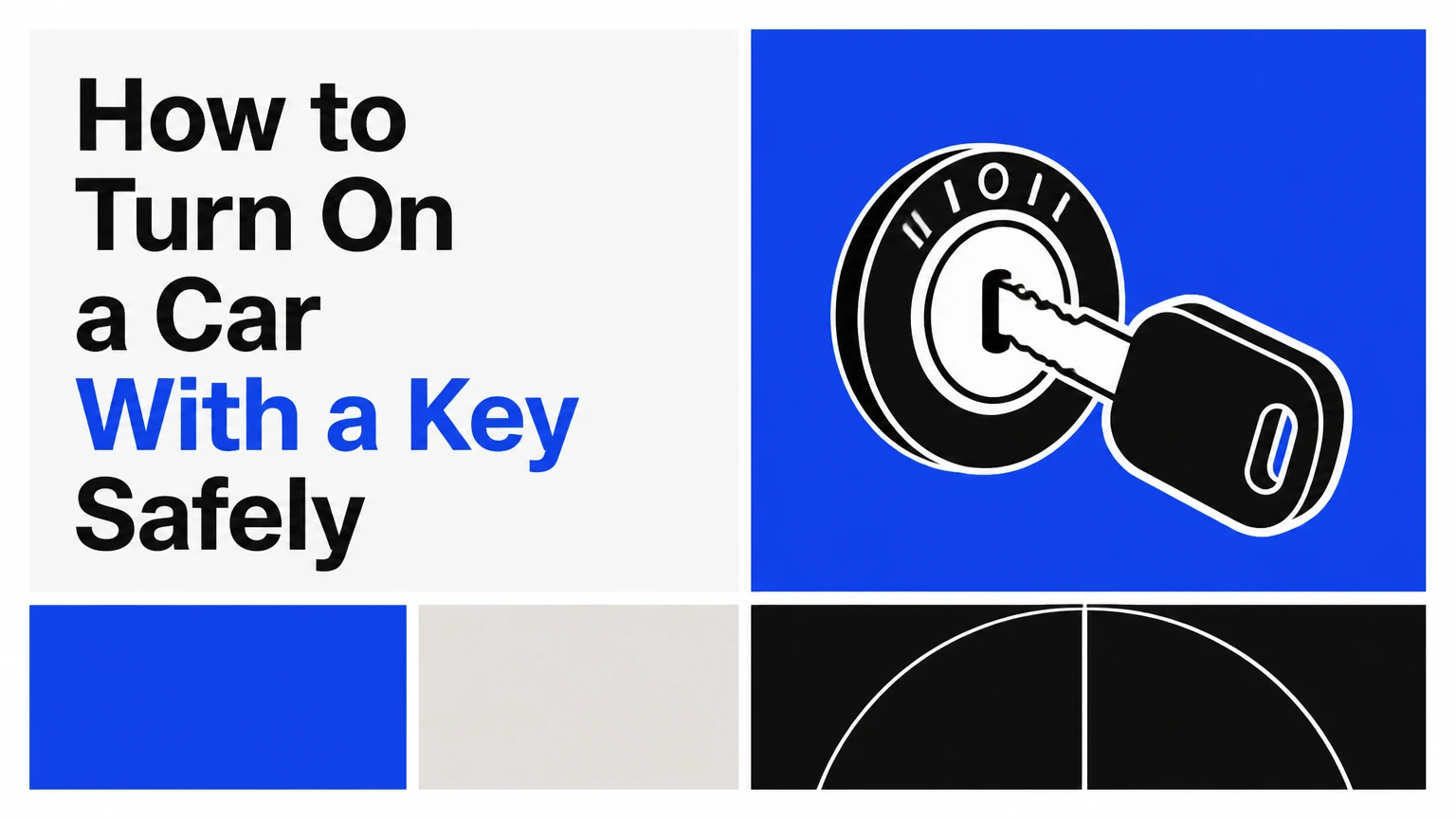
To turn on a car with a key, engage the parking brake, select Park or Neutral, press the brake or clutch, insert the correct key, turn it to ON, then rotate it briefly to START. Release the key as soon as the engine runs. The vehicle’s transmission position, battery condition, and immobilizer recognition determine whether the procedure succeeds.
Key Facts at a Glance
An automatic car normally starts only in Park or Neutral with the brake pedal depressed.
A manual car should be in Neutral with the clutch pedal fully pressed and the parking brake engaged.
The key positions are LOCK, ACC, ON/RUN, and spring-loaded START.
Turn the key to START for about 1-3 seconds, then release it when the engine fires.
Do not hold START continuously for more than about 5-10 seconds; follow the owner’s manual if it specifies a shorter limit.
A transponder key can turn the ignition mechanically while still being rejected electronically by the immobilizer.
Before You Start the Car
A typical key-start procedure takes 10-20 seconds and requires no tools. The main prerequisite is a correctly cut and recognized key, while the main safety requirement is preventing unintended vehicle movement.
| Requirement | Automatic transmission | Manual transmission |
|---|---|---|
| Selector or gear | Park, P, or Neutral, N | Neutral |
| Pedal pressed | Brake pedal fully down | Clutch pedal fully down |
| Parking brake | Firmly engaged | Firmly engaged |
| Key type | Mechanical or transponder key | Mechanical or transponder key |
| Typical starting time | 2-5 seconds | 2-5 seconds |
| Main movement risk | Car can creep if not in Park | Car can lurch if in gear |
Before inserting the key, sit in the driver’s seat, adjust your position, and confirm that loose objects are away from the pedals. Check the fuel gauge and make sure the exhaust area is not blocked by snow, mud, or another object, especially in a garage or enclosed space.
Never run a gasoline or diesel engine in a closed garage. Carbon monoxide can accumulate without a reliable warning smell. The National Highway Traffic Safety Administration advises keeping vehicles and combustion engines outside or ensuring that exhaust gases cannot enter an occupied structure.
How to Turn On a Car With a Key
Follow these five steps: secure the vehicle, select the correct gear, press the required pedal, switch to ON, and crank briefly in START. The engine should begin running within a few seconds if the battery, fuel or diesel supply, starter, ignition system, and immobilizer are working correctly.
Step 1: Engage the Parking Brake
Pull up the parking-brake lever, press the parking-brake pedal, or activate the electronic parking brake. Automatic vehicles should still use the parking brake on slopes because Park relies on a transmission parking pawl rather than a full wheel restraint.
Success checkpoint: The parking-brake indicator appears on the instrument cluster, or the lever and pedal provide firm resistance.
Common mistake: Pressing the accelerator while starting. The accelerator is normally unnecessary on modern fuel-injected vehicles and can worsen a flooded-engine condition.
Step 2: Select Park or Neutral and Press the Pedal
For an automatic transmission, move the selector to Park and press the brake pedal firmly. Some vehicles also permit starting in Neutral, which is useful when diagnosing a faulty Park-position switch.
For a manual transmission, place the gear lever in Neutral and press the clutch pedal fully to the floor. Depressing the clutch separates the engine from the transmission and reduces starter load, while the neutral position prevents the vehicle from moving forward or backward.
Success checkpoint: The selector displays P or N, or the manual gear lever moves freely from side to side.
Common mistake: Assuming the car is in Neutral because the lever feels loose. Confirm the gear position before turning the key, particularly on an incline.
Step 3: Insert the Correct Key Fully
Insert the vehicle key into the ignition cylinder with the cut blade aligned naturally. A worn key may enter the cylinder but fail to move the internal wafers into the correct position.
A transponder key has a coded electronic chip in the head or housing. The metal blade operates the lock cylinder, but the engine control system separately checks the chip. Therefore, a copied metal blade may unlock the door and turn the cylinder without starting the engine.
Success checkpoint: The key slides in smoothly and reaches the normal insertion depth without force.
Common mistake: Using a duplicate that was cut from a worn key. The duplicate can reproduce the original wear and create a poor fit.
Step 4: Turn the Key to ON or RUN
Rotate the key clockwise from LOCK through ACC to ON or RUN, stopping before the spring-loaded START position. The dashboard warning lamps should illuminate, and many gasoline vehicles will briefly run the electric fuel pump.
Wait approximately 2 seconds before cranking if the vehicle has been parked for a long period or has recently run out of fuel. Diesel vehicles may require a longer wait until the glow-plug or “wait to start” indicator turns off, particularly below freezing.
| Key position | Electrical state | Typical driver action | Engine status |
|---|---|---|---|
| LOCK or OFF | Steering lock and most circuits inactive | Insert or remove key | Off |
| ACC | Radio, accessory socket, and selected electronics powered | Use accessories without running engine | Off |
| ON or RUN | Instrument cluster, engine control module, fuel and ignition systems powered | Check warning lights and prepare to start | Off |
| START | Starter solenoid and motor receive power | Crank engine briefly | Cranking or running |
Success checkpoint: The instrument cluster lights up, and the immobilizer indicator behaves normally according to the owner’s manual. A short fuel-pump hum may be audible from the rear.
Common mistake: Treating every dashboard light as a fault. Oil-pressure, battery, and check-engine lamps commonly illuminate before the engine starts, then should go out after the engine runs.
Step 5: Turn to START and Release Immediately
Turn the key farther clockwise against the spring until the starter motor engages. Hold it for about 1-3 seconds, or until the engine starts, then release the key so it returns automatically to ON or RUN.
The starter motor turns the crankshaft, allowing the engine control system to provide fuel and ignition or compression-assisted combustion. If the engine does not start after one attempt, return the key to LOCK or OFF, wait 10-15 seconds, and diagnose the symptom before trying again.
Success checkpoint: The engine runs at a steady idle, the starter noise stops, and the key springs back to ON.
Common mistake: Keeping the key in START after the engine fires. A starter designed for cranking can be damaged if it remains engaged with a running engine.
What Happens Inside the Ignition System?
A keyed ignition system combines a mechanical lock cylinder, an electrical ignition switch, a starter circuit, and, on many modern vehicles, an electronic immobilizer. Turning the key does not directly create combustion; it requests electrical power and starter operation while the engine-control system verifies the key code.
The ON position powers the engine control module, dashboard, fuel-pump relay, ignition coils, injectors, and safety systems according to the vehicle design. In START, a low-current ignition-switch signal activates a relay or starter solenoid, which connects high battery current to the starter motor.
The starter gear engages the engine’s ring gear or flywheel. Once combustion sustains engine speed, releasing the key removes the start signal and allows the starter gear to disengage. Modern vehicles often include a starter-interlock system that prevents cranking unless Park, Neutral, or the clutch condition is detected.
Which Type of Key Does the Car Use?
The vehicle’s key type determines whether cutting alone is sufficient or electronic programming is also required. Traditional metal keys need the correct mechanical cut, while transponder and remote keys may require a code match with the immobilizer or body-control module.
| Key type | Mechanical function | Electronic function | Typical replacement cost in the US | Typical time |
|---|---|---|---|---|
| Basic metal key | Cuts ignition and door tumblers | None | $5-$20 | 5-15 minutes |
| Transponder key | Cuts ignition cylinder | Immobilizer identification | $40-$180 | 20-60 minutes |
| Laser or sidewinder key | Precise high-security blade cut | Often includes transponder | $100-$300 | 30-90 minutes |
| Flip or switchblade key | Folding mechanical blade | Remote locking and often transponder | $100-$350 | 30-90 minutes |
| Integrated remote key | Mechanical emergency blade | Remote entry and immobilizer | $150-$500 | 30-120 minutes |
These are typical US market ranges, not universal prices. Dealer labor, vehicle year, regional locksmith rates, proof-of-ownership requirements, and whether a working key remains can change the total substantially.
A locksmith or dealer generally needs the vehicle identification number, registration or title, government identification, and sometimes the existing key. Keep at least one programmed spare outside the vehicle. Programming a spare while one working key remains is usually less expensive than recovering an all-keys-lost vehicle.
What If the Car Has a Manual Transmission?
Start a manual-transmission car with the gear lever in Neutral, the clutch fully depressed, and the parking brake engaged. Turn the key to ON, wait for the warning lamps to stabilize, then turn to START and release it as soon as the engine runs.
Some manual vehicles include a clutch-start switch that blocks the starter unless the clutch reaches the floor. Others may start without the pedal pressed, but pressing it remains the safer practice because it prevents an unexpected lurch if the transmission is accidentally in gear.
Do not use the accelerator during a normal cold start unless the owner’s manual specifically instructs you to do so. If the engine starts and stalls, keep the clutch depressed, return the key to OFF, and investigate fuel, immobilizer, or idle-control symptoms rather than repeatedly revving the engine.
What If the Key Will Not Turn?
A key that will not turn is often caused by steering-wheel pressure against the locking mechanism, a worn key, or a damaged ignition cylinder. Gently move the steering wheel left and right while applying light turning pressure to the key, but never force the blade.
Try the spare key if available. A spare can distinguish a worn key from a failing cylinder. If the key turns only after repeated manipulation, arrange a repair before the cylinder locks completely, because extracting a broken key or replacing a seized ignition assembly costs more than addressing early wear.
| Symptom | Likely cause | Safe first check | Stop condition |
|---|---|---|---|
| Key will not enter | Dirt, damaged blade, wrong key | Inspect blade and cylinder opening | Do not insert tools into cylinder |
| Key enters but will not rotate | Steering lock or worn key | Move wheel gently while turning | Do not twist hard |
| Key rotates loosely | Broken linkage or cylinder failure | Stop using ignition | Arrange towing or repair |
| Key sticks in ON | Cylinder or interlock fault | Confirm selector is Park | Do not drive if key cannot return |
| Key is frozen | Ice or moisture | Warm key and vehicle gradually | Avoid open flame or boiling water |
Graphite products are not automatically suitable for every ignition cylinder. Some manufacturers prefer a specific dry lubricant, while excess powder can contaminate electrical contacts. Follow the owner’s manual or use a locksmith-approved product instead of spraying general-purpose oil into the cylinder.
Why Does the Car Click or Stay Silent?
A single click or complete silence usually indicates a weak battery, poor battery connection, starter-solenoid fault, or a transmission-interlock problem. A rapidly clicking starter commonly indicates that battery voltage collapses under load, while silence can occur before the starter receives any signal.
Turn the interior light or headlamps on and observe their brightness. If the lights become very dim during an attempted start, inspect the battery terminals and consider a correctly performed jump-start. Do not jump-start a vehicle with a damaged battery, leaking battery, frozen battery, or incompatible electrical system.
| Starting symptom | Most useful clue | Common causes | Next action |
|---|---|---|---|
| No sound | No starter engagement | Dead battery, fuse, interlock, ignition switch | Check battery power and Park or Neutral |
| One heavy click | Solenoid engages once | Weak battery, cable fault, starter motor | Inspect terminals and test voltage |
| Rapid clicking | Voltage repeatedly drops | Discharged battery, poor connection | Charge or jump-start if safe |
| Normal cranking | Starter turns engine | Fuel, spark, compression, immobilizer | Check warning indicators and fuel |
| Slow cranking | Engine turns below normal speed | Weak battery, heavy oil, cable resistance | Test battery and charging system |
A jump-start can restore battery voltage, but it does not repair a failed starter, alternator, fuel pump, ignition coil, or immobilizer. If the vehicle starts with a jump and later stalls or fails again, test the charging system rather than assuming the battery alone is defective.
Why Does the Engine Crank but Not Start?
An engine that cranks normally but does not run has starter operation but lacks fuel, ignition, compression, correct timing, or immobilizer authorization. Check whether the fuel gauge is accurate, whether the security indicator flashes, and whether the engine briefly catches before stopping.
Repeatedly cycling the key from OFF to ON may help some older gasoline vehicles prime a fuel system after it has been opened or run empty, but it will not fix a failed fuel pump or an immobilizer fault. Do not use this technique on a diesel system unless the manufacturer specifies the correct priming procedure.
A gasoline engine that has been flooded may show a strong fuel smell and crank without firing. Some vehicles clear excess fuel when the accelerator is held fully down during cranking, but that procedure varies by engine-management system. Use the owner’s manual, and limit each crank attempt to the manufacturer’s stated duration.
What Does a Flashing Key or Security Light Mean?
A flashing key, padlock, or security indicator usually means the immobilizer has not accepted the transponder code. The engine may crank briefly and stop, or the starter may be disabled entirely, depending on the vehicle’s design.
Remove the key, close the doors, wait about 30-60 seconds, and try the spare programmed key. Keep other coded keys, metal objects, and aftermarket electronic devices away from the ignition during testing, because some vehicles can be affected by key-fob interference or a weak transponder signal.
If both keys fail, the fault may involve the antenna ring around the ignition, the body-control module, low system voltage, or lost programming. A dealer or automotive locksmith will need to verify ownership and use vehicle-specific diagnostic equipment. Cutting another blade without programming will not solve an electronic recognition fault.
Can You Start a Key-Start Car Without the Key?
You should not bypass a keyed ignition or immobilizer to start a vehicle without authorization. A physical key may be replaced by an automotive locksmith or dealer after ownership is verified, but hot-wiring instructions can defeat theft protections and damage wiring, control modules, or the starter circuit.
A lost-key replacement normally involves cutting a mechanical blade and programming a transponder when the vehicle has one. Some manufacturers provide an emergency procedure for a remote fob with a depleted battery, but that procedure is model-specific and does not apply to every keyed ignition.
The safest alternatives are a programmed spare key, roadside assistance, an automotive locksmith, or the vehicle manufacturer’s authorized service network. A tow may be necessary when all keys are lost and programming equipment cannot be used at the vehicle’s location; safe no-key towing options use equipment that prevents damage to locked drive wheels, the transmission, and steering system.
How Do Cold Weather and Diesel Engines Change the Procedure?
Cold weather can reduce battery output, thicken engine oil, freeze moisture in the lock, and increase the time needed for diesel glow plugs to warm. The driver should use the correct oil grade, wait for the diesel preheat indicator, and avoid repeated long cranking.
| Situation | Normal adjustment | Avoid | Practical limit |
|---|---|---|---|
| Gasoline engine below freezing | Wait 2-5 seconds at ON | Pumping accelerator repeatedly | 1-3 second crank attempts |
| Diesel engine below freezing | Wait until glow-plug light goes out | Cranking before preheat completes | Follow manual preheat cycle |
| Frozen lock cylinder | Warm key and use approved de-icer | Open flame and boiling water | Stop if key remains immobile |
| Weak cold battery | Use charger or approved jump pack | Repeated attempts with dim lights | Recharge before further cranking |
| Snow around exhaust | Clear tailpipe and surrounding area | Running engine in enclosed space | Keep exhaust fully unobstructed |
A portable jump starter must match the vehicle’s voltage and have adequate capacity. Connect it exactly as specified by the jump-pack and vehicle manuals. Incorrect polarity can damage sensitive electronic systems.
Common Mistakes and How to Fix Them
The most damaging starting mistakes involve excessive cranking, starter engagement after ignition, forced key movement, and unsafe gear selection. Correcting the procedure is usually safer than adding fuel, throttle, or electrical accessories without diagnosis.
- Holding START too long: Stop after approximately 5-10 seconds, then wait 10-15 seconds before another attempt. Longer cranking overheats the starter and cables.
- Re-cranking a running engine: Release the key immediately when the engine fires. The starter pinion can clash with the rotating flywheel or ring gear.
- Forcing the steering lock: Apply only gentle key pressure while moving the wheel. A snapped blade inside the cylinder creates a second repair problem.
- Starting in an unknown gear: Confirm Park, Neutral, or full clutch depression before cranking. A vehicle can move even when the driver expects the engine merely to turn over.
- Ignoring the immobilizer light: Try the spare programmed key rather than ordering an unprogrammed metal duplicate.
- Using a heavy keychain: Large loads can accelerate wear in the ignition cylinder and alter key alignment while driving.
One practitioner rule is especially useful: separate “no crank” from “crank but no start” before buying parts. A no-crank fault points toward battery power, cables, interlocks, ignition switching, or the starter; a crank-no-start fault points toward fuel, ignition, compression, timing, or authorization.
When Should You Stop Trying and Get Help?
Stop attempting to start the vehicle when you smell fuel strongly, see smoke, hear grinding, find damaged battery cables, or notice the key becoming hot. Stop immediately if the vehicle moves unexpectedly, the starter remains engaged, or the battery shows leakage or swelling.
Roadside assistance is appropriate for a discharged battery, flat tire, locked-out vehicle, or safe tow. An automotive locksmith is appropriate for a broken, lost, or unprogrammed key. A repair shop is appropriate for repeated no-start faults, grinding starter noise, a seized ignition cylinder, or a security light that remains active with every programmed key.
Do not keep cycling the ignition when the engine bay contains spilled fuel. Do not run the engine indoors to test a repair. These limits matter more than completing another starting attempt.
How Much Do Key and Starting Repairs Cost?
Key replacement is typically less expensive when one working key remains, while no-crank repairs range from a simple battery connection to a starter or ignition-cylinder replacement. The figures below are typical US consumer ranges and exclude unusual luxury-vehicle programming or towing.
| Service or part | Typical parts cost | Typical labor or programming | Typical total |
|---|---|---|---|
| Basic metal duplicate | $5-$20 | $0-$20 | $5-$40 |
| Transponder-key replacement | $40-$180 | $40-$150 | $80-$330 |
| Remote or flip key | $75-$300 | $50-$200 | $125-$500 |
| 12-volt battery replacement | $100-$300 | $20-$80 | $120-$380 |
| Starter replacement | $150-$600 | $200-$800 | $350-$1,400 |
| Ignition-cylinder replacement | $100-$400 | $200-$700 | $300-$1,100 |
Dealer prices can exceed locksmith prices for a key, but dealers may be necessary for certain immobilizer systems or all-keys-lost programming. Compare the complete quote, including cutting, programming, mobile service, diagnostic fees, and towing.
FAQ
Do you turn the key slowly or quickly?
Turn the key smoothly through ACC to ON, pause briefly, then rotate it firmly to the spring-loaded START position. Do not snap the key or force it through resistance. Release it immediately when the engine runs so the ignition returns to ON.
Should you press the gas pedal when starting a car with a key?
Most modern fuel-injected cars start without pressing the accelerator. Pressing the pedal can interfere with normal cold-start control, while some flooded-engine procedures require a fully depressed accelerator. Use the owner’s manual for that exception rather than guessing.
How long should you wait between starting attempts?
Wait about 10-15 seconds between short cranking attempts so the starter and battery can recover. After several failed attempts, stop and diagnose the symptom. Continued cranking can discharge the battery, overheat the starter, or flood some gasoline engines.
Can a dead key-fob battery prevent a keyed car from starting?
A dead remote battery does not always prevent a keyed car from starting because many ignition keys contain a separate passive transponder. If the vehicle does not recognize the key, hold the fob at the manufacturer-specified backup location or use the emergency procedure in the owner’s manual.
Why does the car start and then immediately stall?
Immediate stalling can result from an unrecognized immobilizer code, inadequate fuel pressure, a failed crankshaft sensor, or an idle-control problem. A flashing security lamp strongly supports an authorization fault, while normal cranking with no security warning requires broader fuel and ignition diagnosis.
Is it safe to leave the key in the ON position?
Leaving the key in ON with the engine off can drain the battery because the dashboard, control modules, fuel-system circuits, and accessories may remain powered. Use ACC for limited accessories when appropriate, and return the key to LOCK or OFF after testing.
The Bottom Line
To turn on a car with a key, engage the parking brake, select Park or Neutral, press the brake or clutch, turn the key to ON, wait for the normal dashboard sequence, and crank in START for about 1-3 seconds. Release the key as soon as the engine runs. If the vehicle will not start, classify the symptom as no crank, slow crank, crank-no-start, or immobilizer failure before attempting repairs. A spare programmed key, a healthy battery, and gentle handling of the ignition cylinder prevent many avoidable problems.